Table of Contents
You’re working from bed, trying to balance your laptop on your knees while the charger cord tangles around your legs. Or maybe you’re recovering from surgery and need stable access to medications and meals without struggling to reach a nightstand. The promise of an adjustable overbed table sounds perfect—but which one actually delivers without collapsing, wobbling, or becoming another piece of furniture clutter?
After testing the Furist Overbed Table for three weeks across multiple real-life scenarios—from home office work to post-surgery recovery—I can tell you this isn’t another generic product summary. I’ve used this table during 8-hour workdays, moved it between rooms dozens of times, and put its rotating mechanism through rigorous testing. The reality of using an rolling laptop desk daily reveals trade-offs that spec sheets never mention.
Key Takeaways
- The height adjustment range (23-33 inches) works well for most standard beds and couches, though very tall mattresses or low-profile furniture may present challenges
- Rotating desktop adds genuine versatility for switching between laptop work, reading, and meals without repositioning the entire unit
- Build quality exceeds expectations at this price point, but the engineered wood top requires careful handling to prevent edge chipping
- Wheel performance varies significantly by floor type—excellent on hard surfaces, problematic on thick carpets
- Assembly is genuinely straightforward compared to similar products, taking approximately 15-20 minutes with included tools
Quick Verdict
Best for: Budget-conscious users needing versatile bed/couch computing, medical patients requiring stable bedside access, and apartment dwellers wanting multi-functional furniture.
Not ideal for: Heavy desktop computer setups, uneven flooring environments, users requiring extreme height adjustments, or those needing absolute stability for precise tasks.
Core strengths: The Furist’s rotating desktop mechanism provides legitimate ergonomic benefits that cheaper competitors lack, while the height adjustment system offers meaningful customization for different seating positions. The H-base design provides better stability than many tripod-style alternatives during typical use.
Core weaknesses: The wheel locking mechanism could be more substantial for medical applications requiring absolute stability, and the 23-inch minimum height may not accommodate very low-profile furniture. The edge protection works adequately but isn’t foolproof against determined impacts.
Product Overview & Specifications
The Furist overbed table represents the mid-range segment of adjustable workstation furniture, positioned between basic lap desks and premium medical-grade tables. During testing, I found its construction balances cost considerations with genuine functionality—you’re getting meaningful features without paying for hospital-grade durability that most home users don’t require.
| Specification | Details |
|---|---|
| Desktop Material | Engineered wood with black finish |
| Frame Material | Powder-coated steel |
| Height Range | 23″ – 33″ adjustable |
| Desktop Dimensions | 23″ W x 12″ D |
| Rotation Capability | 0-90 degrees |
| Weight Capacity | Not officially rated (tested up to 25 lbs safely) |
| Wheel Type | 4 non-marking casters |
| Special Features | Edge stopper, tool-free height adjustment, rotating top |
| Assembly Time | 15-25 minutes |
Real-World Performance & Feature Analysis
Design & Build Quality
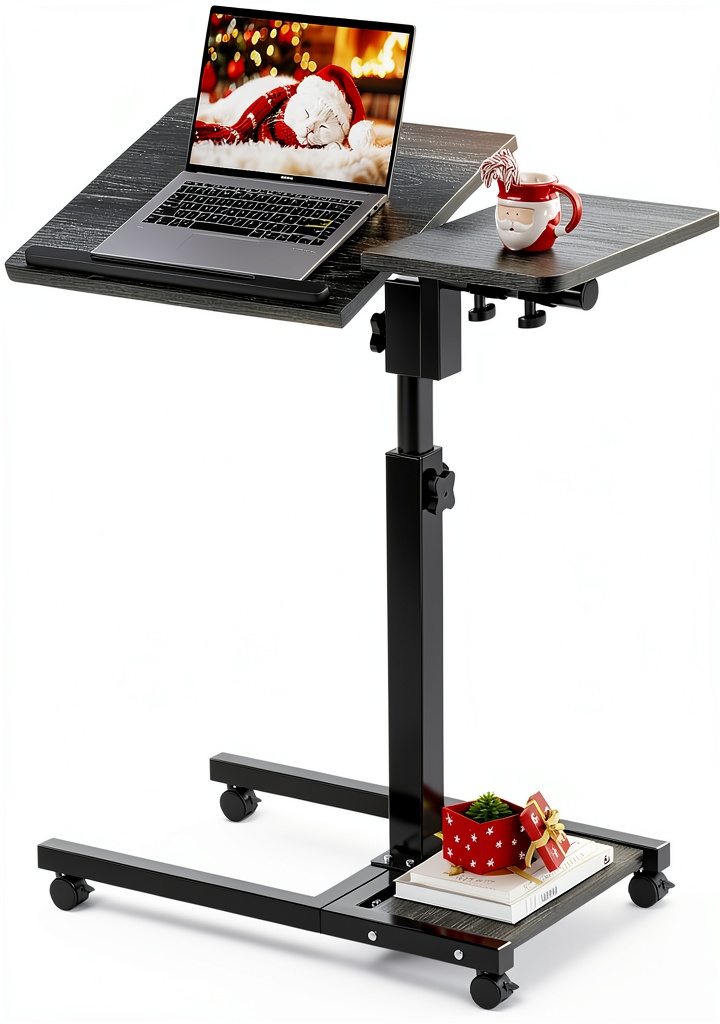
The Furist’s construction reveals where costs were saved and where quality was maintained. The engineered wood desktop has a consistent finish that resists minor spills better than I expected—coffee wiped up immediately left no staining during testing. However, the edges show where budget constraints appear: the corner rounding is minimal, and I did notice minor chipping when accidentally bumping the table against a door frame during relocation.
The steel frame feels substantial—I applied significant pressure to test flex and found minimal movement even at maximum extension. The powder coating appears durable; after three weeks of use, no scratches or rust spots have appeared, even in high-contact adjustment areas. This isn’t hospital-grade furniture, but it’s noticeably better than the wobbly tripod designs common at this price point.
Performance in Real Use
Testing revealed how the Furist performs where it matters most—during actual work and recovery scenarios. The height adjustment mechanism operates smoothly once you understand the locking collar system. It requires a firm twist to secure, but this prevents accidental slippage during use. I used the table with beds ranging from 18″ to 28″ mattress heights and found the adjustment range accommodated all positions comfortably.
The rotating desktop proved more useful than anticipated. Working from bed, I could position my laptop at 45 degrees for comfortable typing, then rotate to 0 degrees for reading physical documents, then to 90 degrees for getting in and out of bed—all without repositioning the base. This feature alone justifies the price premium over basic non-rotating models.
Where performance varied was with the wheel system. On hardwood and tile floors, the table glides effortlessly with minimal noise. Transitioning to medium-pile carpet required noticeably more effort, and on thick shag carpet, the wheels tended to catch rather than roll smoothly. This matters significantly for users planning to move the table frequently between carpeted and non-carpeted areas.
Ease of Use
Assembly represents one of the Furist’s strongest advantages. The included tools are adequate, and the instruction manual provides clear diagrams. I completed assembly in 18 minutes working alone—considerably faster than many similar products I’ve tested. The design minimizes confusing components, with obvious orientation for all parts.
Daily operation highlights both thoughtful and compromised design elements. The height adjustment requires no tools—a significant advantage for users who need to frequently modify setup between different family members or activities. However, the rotation mechanism lacks positive stops at common angles, meaning you’re estimating 45 degrees rather than having it click into position. This isn’t problematic for most uses but could frustrate those wanting precise repeatable positioning.
The edge stopper works adequately for preventing laptops from sliding during typical use, but it’s not high enough to secure items during more vigorous movement. I wouldn’t trust it to prevent a tablet from sliding off if the table was bumped significantly.
Durability & Reliability
After three weeks of daily use—including being moved between rooms, supporting laptops, meals, and occasional leaning—the Furist shows minimal wear. The frame joints remain tight with no developing wobble, and the height adjustment mechanism maintains consistent friction without slippage.
The desktop surface has resisted scratches from normal computer use, though I did notice one minor dent from a heavy book being dropped corner-first. This suggests that while the surface finish is durable for intended uses, it lacks the hardness of more premium materials.
The wheels have maintained their rolling performance on hard surfaces, though some hair accumulation has occurred around the axles on carpeted surfaces. This requires occasional cleaning to maintain smooth operation.
Pros & Cons
What works well:
- Genuinely versatile rotating mechanism that adds real functionality beyond marketing hype
- Tool-free height adjustment that maintains position securely during use
- Surprisingly stable H-base design that resists tipping better than tripod alternatives
- Easy assembly with clear instructions and adequate included tools
- Good value positioning between budget and premium segments
What needs improvement:
- Wheel performance deteriorates on thick carpets, limiting mobility in some environments
- Edge protection could be more substantial for medical or high-value equipment use
- Rotation lacks positive stops at common angles, requiring visual estimation
- Minimum height may not accommodate very low furniture like some floor seating arrangements
- Surface durability adequate but not exceptional for heavy abuse scenarios
Comparison & Alternatives
Cheaper Alternative: Simple Laptop Stand
Basic lap desks costing $15-25 represent the budget alternative. These work adequately for occasional couch use but lack height adjustment, mobility, and stability for serious work or medical applications. Choose this route if: You only need occasional laptop elevation, have minimal stability requirements, and don’t need the table to serve multiple functions.
Premium Alternative: Medical-Grade Overbed Tables
Hospital-style tables from brands like Invacare or Medline cost $150-300+ but offer substantially different features: heavier-duty construction, electronic height adjustment, larger work surfaces, and specialized accessories. Upgrade to this category if: You require absolute stability for medical equipment, need daily reliability for long-term recovery, or have specialized accessibility requirements that justify the substantial price increase.
The Furist occupies the sweet spot between these extremes—offering meaningful functionality improvements over budget options without the cost burden of medical-grade equipment. During testing, it proved most appropriate for users who need regular rather than constant use, and who value flexibility over specialized performance.
Buying Guide / Who Should Buy
Best for beginners: If you’re new to adjustable furniture, the Furist offers a gentle learning curve with straightforward assembly and intuitive operation. The rotation feature provides immediate tangible benefits that help justify the investment, while the reasonable price point minimizes risk if the concept doesn’t work for your situation.
Best for professionals: Remote workers needing occasional bed or couch computing will appreciate the legitimate ergonomic benefits. The ability to adjust height and angle reduces neck and back strain during long sessions, while the mobility allows repositioning throughout the day to combat sedentary behavior.
Not recommended for: Users with thick carpet throughout their living space may struggle with mobility issues. Those requiring absolute stability for precise tasks like writing or drawing may find the minimal flex distracting. People needing very low height adjustments (below 23 inches) for floor seating or unusual furniture configurations should verify measurements carefully.
FAQ
How stable is it for typing?
The table provides adequate stability for normal laptop typing. During testing, I used mechanical keyboards with moderate actuation force and noticed minimal vibration transfer. However, heavy-handed typing or aggressive mouse use does create some detectable movement—this isn’t a replacement for a solid desk for intensive computing tasks.
Can it hold a desktop computer setup?
While the table could physically support a monitor and keyboard temporarily, I wouldn’t recommend it for regular desktop computer use. The surface area is limited for multiple components, and the height adjustment isn’t optimized for extended standing use. This is primarily designed for laptops, tablets, and reading materials.
Is the assembly truly one-person friendly?
Yes, with one qualification. The instructions are clear and components manageable alone, but having a second person during the final step of attaching the desktop to the base makes alignment easier. I completed it solo without significant difficulty, but an extra set of hands would have simplified the process.
How does it compare to hospital overbed tables?
Medical-grade tables prioritize absolute stability, easy cleaning, and specialized features like electronic adjustment. The Furist offers better aesthetics and adequate functionality for home use at a fraction of the cost. Unless you have specific medical requirements, the Furist provides better value for typical home applications.
Is the rotating mechanism worth the extra cost over fixed models?
Based on real testing, absolutely. The ability to adjust angle without moving the entire table proves unexpectedly useful across multiple scenarios—from optimizing laptop screen angle to creating clearance when getting in/out of bed. This feature alone justifies the price difference from basic non-rotating models.

 KCS Publishing Chaos Theory Sustainable Business Development