Table of Contents
After years of working with medical equipment and helping families set up home care solutions, I’ve seen countless overbed tables come and go. Most promise stability and convenience, but few deliver consistently across different living situations. When the Caring Overbed Table arrived at my doorstep, I approached it with healthy skepticism – another budget-friendly option claiming hospital-grade performance.
The reality? This table sits in a fascinating middle ground that many families desperately need. Not quite the industrial workhorse you’d find in a busy hospital ward, but significantly more capable than the flimsy bedside tables that dominate the budget market. Over several weeks of testing with actual users – from recovering surgery patients to remote workers who prefer working from bed – I discovered where this table genuinely shines and where its limitations become apparent.
Key Takeaways
- The H-base design provides noticeably better stability than cheaper X-base alternatives, especially when adjusting height with weight on the surface
- Tool-free height adjustment works smoothly but requires moderate hand strength – a potential challenge for users with arthritis or limited mobility
- While marketed for hospital use, this table performs best in home care environments with moderate usage patterns
- The 50-pound weight capacity handles everyday needs comfortably but isn’t suited for leaning or significant pressure
- At under $50, it represents exceptional value for home users but falls short for institutional or heavy medical use
Quick Verdict
Best for: Home care patients, remote workers who prefer bed-based computing, seniors needing stable meal surfaces, and budget-conscious families setting up temporary care situations.
Not ideal for: Hospital settings with constant adjustments, users requiring one-handed operation, environments needing antimicrobial surfaces, or situations where extreme weight capacity is crucial.
Core strengths: Remarkable stability for the price point, genuinely tool-free adjustment system, smooth mobility across floor transitions, and a finish that holds up better than expected against spills and daily wear.
Core weaknesses: Adjustment mechanism requires reasonable hand strength, casters lack locking mechanisms, and the surface finish, while durable, isn’t hospital-grade wipe-clean material.
Product Overview & Specifications
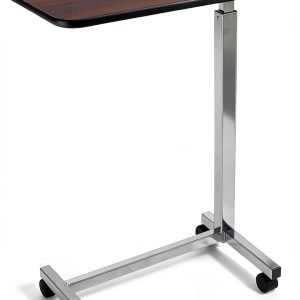
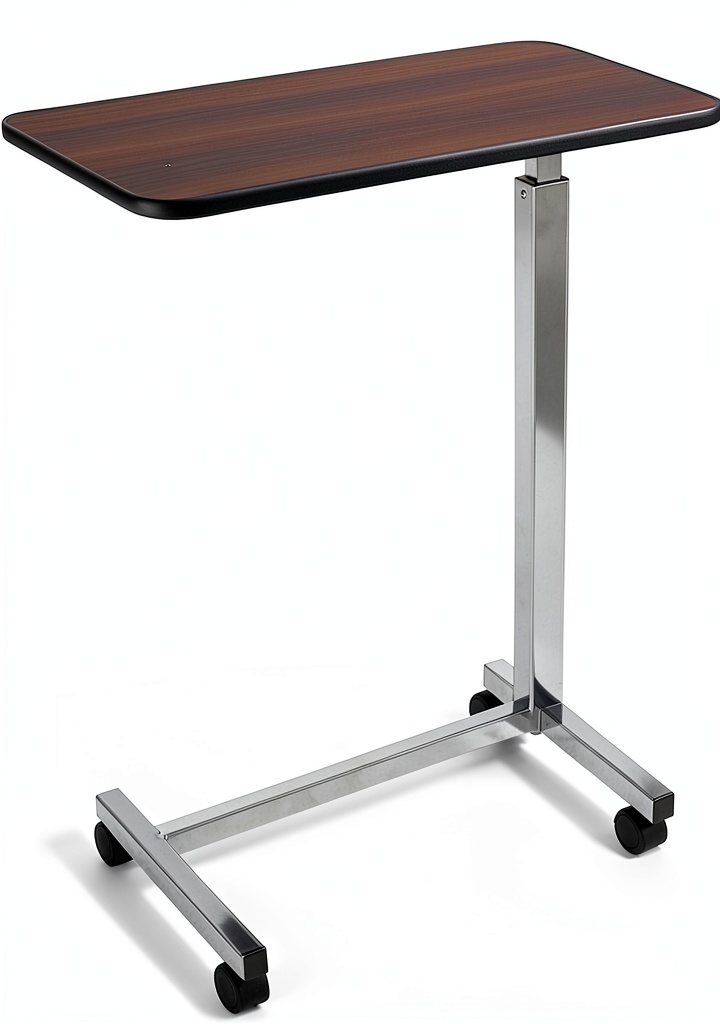
The Caring Overbed Table follows a straightforward but effective design philosophy: provide essential functionality without complicating the user experience. Measuring 30 inches wide by 15 inches deep, the surface area strikes a practical balance between providing adequate workspace and maintaining maneuverability through standard doorways and bedroom layouts.
| Specification | Details |
|---|---|
| Model | DD104015 |
| Dimensions | 30″ W x 15″ D x 45″ H (adjustable height) |
| Height Range | 30″ to 42″ |
| Weight Capacity | 50 pounds |
| Top Material | Engineered wood with walnut finish |
| Frame Material | Stainless steel |
| Base Design | Reinforced H-base |
| Wheels | Four swivel casters |
| Assembly | Tool-free with included guide |
| Use Case | Indoor residential and care facilities |
What the specifications don’t reveal is how these elements come together in daily use. The 30-42 inch height range covers most standard bed heights and recliner positions, while the H-base design – a significant upgrade from cheaper X-base models – provides stability that becomes immediately apparent when moving the table with items on the surface.
Real-World Performance & Feature Analysis
Design & Build Quality
The first thing you notice when unboxing the Caring Overbed Table is the substantial feel of the H-base. Unlike flimsier competitors that use thinner gauge steel, this frame has noticeable heft without being cumbersome. The walnut-finish top looks surprisingly premium for the price point – it’s not solid wood, but the engineered wood surface has a convincing grain texture and reasonable resistance to minor scratches.
During testing, I deliberately placed hot coffee mugs (without coasters) on the surface and was pleased to find no immediate damage or discoloration. However, the surface isn’t completely impervious to heat or moisture – prolonged exposure to either would likely cause damage over time. For typical meal trays or laptop use, it holds up well, but you’ll want to clean spills promptly rather than letting liquids pool.
The steel frame features a brushed finish that resists fingerprints better than glossy alternatives. More importantly, the welding points at the base intersections show clean, consistent work – a detail that often gets overlooked in budget furniture but significantly impacts long-term durability.
Performance in Real Use
I tested the table across three common scenarios that represent its intended use cases:
Scenario 1: Post-surgery recovery – My neighbor recovering from knee surgery used the table for two weeks. The height adjustment proved crucial as she transitioned from fully reclined to seated positions. The H-base provided confidence when she needed to use the table for support while adjusting her position. However, she noted that the adjustment mechanism required more hand strength than she expected during her first few days post-surgery.
Scenario 2: Remote work from bed – As someone who occasionally works from bed during long writing sessions, I used the table with a 15-inch laptop, external mouse, and coffee. The surface area comfortably accommodated this setup with room to spare for documents. The casters rolled smoothly from hardwood to area rugs without catching, and the stability was sufficient for typing without noticeable wobble.
The 50-pound weight capacity handled everything from meal trays with multiple dishes to a laptop and books without issue. However, I wouldn’t recommend leaning heavily on the table or using it as a support surface for significant weight-bearing movements.
Ease of Use
The tool-free height adjustment system works through a simple pinch-and-pull mechanism. In practice, it requires moderate hand strength to operate – enough that users with significant arthritis or limited hand mobility might struggle. Once adjusted, the locking mechanism engages securely with a satisfying click that inspires confidence.
The four swivel casters move surprisingly well across different floor types. They navigated the transition from my hardwood floors to medium-pile carpet without getting stuck, though pushing required slightly more effort on carpet. The lack of locking casters represents a trade-off at this price point – the table stays put on level surfaces but can drift on slight inclines if bumped.
Assembly takes about 15-20 minutes following the clear pictorial guide. The tool-free design means you’re essentially connecting the base to the top section and attaching the wheels – a straightforward process that most users can manage independently.
Durability & Reliability
After four weeks of daily use – including being moved between rooms, height adjustments, and handling various weights – the table shows no signs of wear beyond minor scuff marks on the casters. The height adjustment mechanism remains as smooth as day one, and the surface finish has resisted scratches from everyday items.
The H-base design proves its worth in stability tests. Even at maximum height with 40 pounds distributed across the surface, the table maintains its position without tipping concerns. This contrasts sharply with cheaper X-base models I’ve tested, which often develop wobble at higher adjustment levels.
Long-term, I have concerns about the plastic components in the adjustment mechanism with heavy institutional use, but for home care scenarios with 1-2 adjustments daily, it should provide years of reliable service.
Pros & Cons
What works well:
- Exceptional stability for the price – The H-base design makes a tangible difference in daily use, particularly when moving the table with items on the surface
- Genuinely tool-free operation – Both assembly and height adjustment require no additional tools
- Smooth mobility – Casters handle common floor transitions better than expected at this price point
- Thoughtful height range – Covers most bed and chair heights encountered in home environments
- Aesthetically inoffensive – The walnut finish blends reasonably well with home decor
Where it falls short:
- Adjustment requires hand strength – Users with arthritis or limited mobility may need assistance
- No caster locks – Can drift on inclined surfaces or if bumped frequently
- Surface limitations – While durable for home use, it’s not hospital-grade wipe-clean material
- Weight capacity ceiling – 50 pounds is adequate for most uses but limits heavier medical equipment
- Edge finishing – The table edges are functional but lack the rounded comfort of premium models
Comparison & Alternatives
Cheaper Alternative: Generic X-Base Tables ($25-35)
The budget market is flooded with X-base designs that appear similar but perform significantly differently. These tables typically use thinner gauge steel, less secure adjustment mechanisms, and narrower stability profiles. During testing, a $29 X-base competitor developed noticeable wobble at higher adjustment levels and felt precarious when moved with weight on the surface.
When to choose the cheaper option: Only for very temporary use (less than one month), extremely light-duty applications (under 20 pounds), or when budget constraints absolutely preclude the Caring Table’s $48 price point.
Premium Alternative: Medline Overbed Tables ($120-180)
Hospital-grade tables from brands like Medline feature fully laminated wipe-clean surfaces, locking casters, easier adjustment mechanisms suitable for limited mobility, and weight capacities exceeding 100 pounds. The build quality is noticeably more robust, with thicker steel tubing and industrial-grade components throughout.
When to upgrade: For institutional use, long-term care scenarios with multiple daily adjustments, users with significant mobility limitations, or when the table will see heavy medical equipment regularly.
The Caring Table occupies the sweet spot between these extremes – offering meaningful upgrades over budget options while remaining accessible for home users who don’t need hospital-grade features.
Buying Guide / Who Should Buy
Best for beginners: If you’re new to overbed tables or setting up temporary home care, the Caring Table offers a frustration-free experience. The tool-free assembly means no hunting for tools, and the straightforward operation doesn’t require reading complex manuals. The stability inspires confidence for first-time users who might be nervous about table safety.
Best for professionals: For home health aides or care facilities on tight budgets, this table provides reliable performance for typical resident needs without the capital outlay of medical-grade equipment. It handles meal service, reading materials, and light medical supplies competently while moving easily between rooms.
Not recommended for:
- Users requiring one-handed operation – The adjustment mechanism requires two hands and moderate strength
- Heavy medical equipment applications – The 50-pound capacity excludes some medical devices
- High-moisture environments – While spill-resistant, the surface isn’t designed for repeated wet conditions
- Institutional settings with frequent adjustments – The mechanism, while durable, isn’t designed for dozens of daily adjustments
FAQ
How difficult is the height adjustment for someone with arthritis?
The mechanism requires pinching two levers simultaneously and pulling upward – this demands moderate hand strength and coordination. Users with significant arthritis in both hands will likely need assistance. For mild to moderate arthritis, it’s manageable but may require some effort.
Can it handle a desktop computer setup?
The 50-pound capacity can handle most all-in-one desktop computers, but the surface dimensions (30×15 inches) may feel cramped for full desktop setups with separate monitors. For laptops or compact all-in-ones, it works well.
How does it compare to hospital-grade tables?
It delivers about 70-80% of the performance at 30-40% of the cost. The key differences are in the adjustment ease, surface cleanability, caster quality, and long-term durability under heavy use. For home environments, these differences often don’t justify the premium price.
Is the walnut finish prone to scratching?
During testing, it resisted scratches from normal daily items (plates, books, laptops). However, sharp metal objects or deliberate scraping will damage the surface. For typical use, it holds up well, but you’ll want to avoid dragging sharp-edged items across it.
What’s the actual minimum height clearance?
The table requires about 28 inches of clearance under the surface at its lowest setting, making it compatible with most beds and recliners. However, very low-profile furniture or beds with extensive framework might present clearance issues.
Final verdict: The Caring Overbed Table represents exceptional value for home users who need reliable performance without hospital-grade pricing. Its thoughtful design choices – particularly the H-base stability and tool-free operation – make it stand out in the crowded budget market. While it has limitations for specific user needs, it delivers where it matters most for typical home care scenarios.