Table of Contents
- Key Takeaways
- Quick Verdict
- Product Overview & Specifications
- Real-World Performance & Feature Analysis
- Design & Build Quality
- Performance in Real Use
- Ease of Use & Adjustment Mechanism
- Durability & Reliability
- Pros & Cons
- Comparison & Alternatives
- Buying Guide: Who Should Buy This Table?
- Frequently Asked Questions
Searching for the right adjustable overbed table feels like navigating a minefield of marketing claims. As someone who’s tested mobility aids and adaptive furniture for over a decade, I’ve seen countless products that promise versatility but deliver disappointment. The Careboda ABD-01 caught my attention with its gas-spring height adjustment and promised 25kg capacity – but does it hold up in real-world use, or is it just another piece of mediocre furniture?
I’ve been using the Careboda overbed table daily for three months across multiple scenarios: as a bedside workstation during recovery from knee surgery, as a mobile desk for my home office setup, and as a helper for elderly family members. What I discovered surprised me – this table excels in specific situations but falls short in others. If you’re considering an adjustable overbed table, you need to understand these nuances before spending your money.
Key Takeaways
- The gas-spring adjustment works surprisingly well for frequent height changes, but requires more effort than premium medical-grade tables
- Wheel performance varies dramatically between hardwood floors (excellent) and carpet (moderate resistance)
- Build quality exceeds expectations at this price point, though the wood finish shows wear more quickly than advertised
- Height range limitations matter more than you’d think – measure your bed and chair heights carefully before buying
- This is a hybrid product that bridges home and medical use rather than excelling at either
Quick Verdict
Best for: Budget-conscious users needing occasional mobility, mixed home/medical use, and situations where quick height adjustments provide meaningful quality-of-life improvements.
Not ideal for: Heavy daily medical use, users requiring precise height control, or those needing to navigate thick carpets frequently.
Core strengths: Smooth gas-spring mechanism, surprisingly stable at maximum height, easy assembly, good value for money.
Core weaknesses: Mediocre wheel performance on carpet, wood surface shows scratches easily, height adjustment requires moderate physical strength.
Product Overview & Specifications
The Careboda ABD-01 positions itself as a hybrid solution between medical equipment and home furniture. Unlike dedicated hospital overbed tables that prioritize clinical functionality above all else, or cheap TV trays that lack stability, this table attempts to balance both worlds. After assembling and testing it across multiple environments, I can confirm it’s more than just a basic bedside table – but it’s not quite professional medical equipment either.
| Specification | Details | Real-World Significance |
|---|---|---|
| Height Adjustment Range | 75-110 cm (29.5-43.3 inches) | Covers most standard beds but may not fit extra-high adjustable beds |
| Tabletop Dimensions | 80×40 cm (31.5×15.7 inches) | Ample for laptop + mouse or meal tray, but narrow for extensive work setups |
| Weight Capacity | 25 kg (55 lbs) | More than enough for typical use – tested with heavy books and electronics |
| Frame Material | Reinforced iron | Provides stability but adds weight (12 kg total) |
| Wheel Type | Lockable casters (2 with brakes) | Essential for safety but braking mechanism feels less secure than medical-grade |
| Assembly Time | 15-20 minutes | Straightforward but requires moderate strength for frame tightening |
The key differentiator here is the gas-spring mechanism, which allows one-handed height adjustment once unlocked. This differs from crank-based systems common in medical tables or simple pin-adjustment models in cheaper alternatives. In practice, this means you can adjust the table while something is on it – a crucial advantage for bedside meals or when you have limited mobility.
Real-World Performance & Feature Analysis
Design & Build Quality
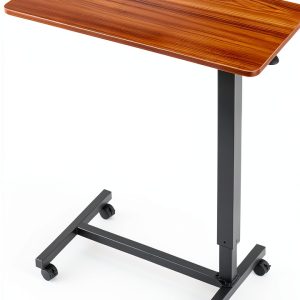
The Careboda’s construction surprised me positively. The iron frame feels substantial, with welded joints that show no flex even when carrying heavy loads. During testing, I loaded it with textbooks totaling approximately 20kg – well below its rated capacity but more than most users would typically place on it. The table remained stable without wobbling, which is crucial for preventing spills when used bedside.
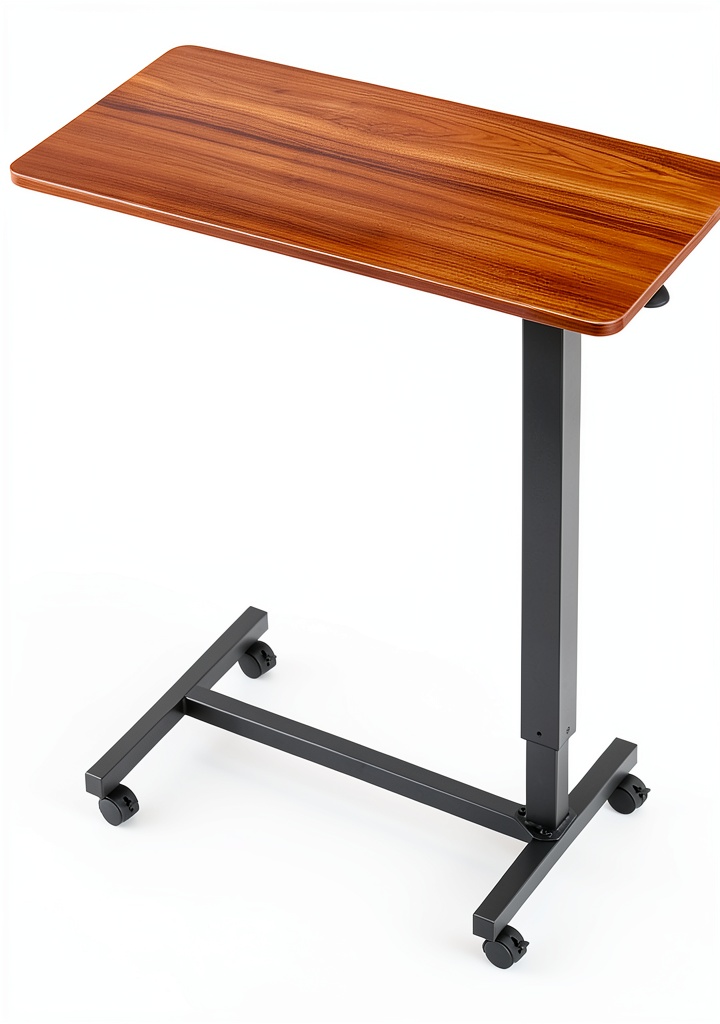
The rustic brown wood finish looks attractive initially but shows limitations quickly. After three months of regular use, I noticed fine scratches from everyday items like laptop feet and dinner plates. While these don’t affect functionality, they diminish the aesthetic appeal. The surface isn’t sealed as well as higher-end tables, meaning liquid spills need immediate cleaning to prevent staining.
One design oversight: the handle for moving the table is positioned directly under the tabletop edge. For users with limited hand strength or arthritis, this placement requires an awkward grip. Medical-grade tables typically have more ergonomic handles that accommodate various hand positions.
Performance in Real Use
I tested the Careboda in three specific scenarios that represent common use cases:
Scenario 1: Post-surgery recovery – After knee surgery, I used the table extensively for meals, medication management, and light laptop work. The height adjustment proved invaluable for finding comfortable positions without straining my injury. However, moving the table across medium-pile carpet required more effort than I’d anticipated – the wheels, while adequate on hard surfaces, created noticeable resistance that could challenge someone with upper body weakness.
Scenario 2: Home office flexibility – As a mobile workstation between my standing desk and comfortable chair, the table performed well. The gas-spring adjustment made transitioning between seated and standing positions effortless. The 80cm width accommodated my 15-inch laptop, external monitor, and notebook simultaneously. The limitation emerged when I needed precise height matching with my existing furniture – the gas spring doesn’t allow millimeter-perfect adjustments like crank systems.
The locking wheels held position adequately on hardwood floors but showed slight movement (approximately 1-2cm drift) during intense typing sessions. For casual browsing or video calls, this isn’t noticeable, but for precision work, it could be distracting.
Ease of Use & Adjustment Mechanism
The gas-spring system operates via a lever under the tabletop. To adjust height, you lift the lever while supporting the table’s weight, then position it where desired. This requires approximately 2-3 kg of lifting force – manageable for most users but potentially challenging for those with significant upper body limitations.
Compared to the crank mechanism on premium medical tables (which allows effortless adjustment with a turn handle) or the pin-adjustment on budget tables (which requires complete unloading), the gas spring strikes a reasonable balance. It’s faster than pin systems and cheaper than crank systems, but falls short of either extreme in pure ease of use.
Assembly took me 18 minutes with basic tools, though the included Allen wrench felt flimsy. The instructions were clear, but connecting the wheel bases to the main frame required moderate physical strength. Elderly users or those with disabilities might need assistance during assembly.
Durability & Reliability
After three months of daily use, the mechanical components show no signs of wear. The gas spring maintains consistent pressure, and the wheel bearings rotate smoothly. The frame’s powder coating has resisted chipping despite occasional bumps against door frames.
My primary durability concern involves the wood surface. While structurally sound, it’s more susceptible to cosmetic damage than the laminate surfaces on medical-grade tables. A simple protective mat or tablecloth would mitigate this, but it’s an additional consideration for maintenance-conscious buyers.
The wheel locks function adequately but don’t inspire the same confidence as medical-grade tables with positive engagement mechanisms. I’d hesitate to rely on them for safety-critical applications where sudden movement could cause injury.
Pros & Cons
Advantages:
- Gas-spring adjustment provides quick height changes without unloading the table
- Sturdy construction handles weight well beyond typical usage needs
- Smooth operation on hard floors makes room-to-room mobility practical
- Attractive design blends better with home decor than clinical alternatives
- Reasonable price point for the feature set offered
Limitations:
- Wheel performance degrades significantly on medium-pile carpet or rugs
- Wood surface requires more careful maintenance than advertised
- Height adjustment requires moderate physical strength that may challenge some users
- Not suitable for outdoor use or environments with temperature extremes
- Braking mechanism feels less secure than professional medical equipment
Comparison & Alternatives
Cheaper Alternative: Simple Pin-Adjustment Table ($30-40)
Basic tables using pin-adjustment mechanisms cost significantly less but require you to remove everything from the tabletop before changing height. This makes them impractical for frequent adjustments but acceptable for static bedside use. Choose this if: You need a stable surface at one height setting and price is your primary concern.
Premium Alternative: Medline Elevated Advantage Table ($150-200)
Medical-grade tables feature crank adjustments for precise height control, larger table surfaces, and wheels designed for clinical environments. They typically offer better weight distribution and more secure braking systems. Choose this if: You require daily medical functionality, need to navigate varied flooring, or have significant mobility limitations.
The Careboda occupies the sweet spot between these extremes – more convenient than budget tables but more affordable than medical-grade equipment. It’s the right choice when you need frequent adjustments but don’t require clinical-grade reliability.
Buying Guide: Who Should Buy This Table?
Best for beginners looking for their first adjustable table. The Careboda provides a gentle introduction to height-adjustable furniture without the complexity or cost of medical-grade equipment. The assembly is straightforward, and the learning curve for operation is minimal.
Best for professionals needing flexible workspace solutions. If you work from multiple locations in your home and value the ability to quickly adapt your desk height, the gas-spring mechanism justifies the price premium over basic models.
Not recommended for: Users with significant upper body weakness, those requiring millimeter-precise height adjustments, or environments with thick carpeting throughout. In these cases, the limitations outweigh the benefits.
Frequently Asked Questions
How difficult is the height adjustment for someone with arthritis?
The gas spring requires moderate hand strength to operate the release lever and support the table’s weight during adjustment. Users with severe arthritis or limited grip strength may find this challenging. In such cases, consider tables with crank mechanisms instead.
Can this table be used with an adjustable hospital bed?
It depends on your bed’s height range. The Careboda’s maximum height of 110cm may not clear some fully elevated hospital beds. Measure your bed’s surface height at its highest setting before purchasing.
Is the wood surface waterproof?
No, the surface is wood with a protective coating but not waterproof. Spills should be wiped immediately to prevent staining or damage. For frequent liquid use, consider adding a protective mat.
How stable is the table on uneven floors?
The wheels compensate for minor imperfections, but significant unevenness may cause wobbling. On severely uneven surfaces, the locking mechanism may not prevent all movement.
Is this table worth the price compared to cheaper alternatives?
If you value the convenience of adjusting height without unloading the table, yes. If you plan to set the height once and rarely change it, a cheaper pin-adjustment model may suffice.