Table of Contents
- Key Takeaways
- Quick Verdict
- Product Overview & Specifications
- Real-World Performance & Feature Analysis
- Design & Build Quality
- Performance in Real Use
- Ease of Use & Adjustment
- Durability & Reliability
- Pros & Cons
- Comparison & Alternatives
- Budget Alternative: Generic Manual-Pin Adjustment Table ($35-50)
- Premium Alternative: Havertys Hydraulic Overbed Table ($150-200+)
- Buying Guide: Who Should Buy This Table
- Best For These Users:
- Not Recommended For:
- Frequently Asked Questions
If you’ve ever tried to work from bed with a laptop balanced on your knees or struggled to find a stable surface for meals while recovering from surgery, you understand the frustration. Traditional bedside tables are often too low, while standard desks aren’t mobile enough. The search for a solution that bridges this gap leads many to adjustable overbed tables—but which one actually delivers on its promises without breaking the bank?
After testing the Careboda ABD-01 Overbed Table for several weeks in real home and office scenarios, I can tell you this isn’t just another piece of medical equipment. It’s a surprisingly versatile tool that serves multiple purposes, but it also has limitations that aren’t obvious from the product description. Whether you’re a remote worker seeking ergonomic flexibility, a caregiver helping someone with mobility issues, or someone recovering from an injury, this hands-on review will give you the unvarnished truth about whether the Careboda is worth your investment.
Key Takeaways
- The gas spring adjustment works smoothly but requires more hand strength than expected for taller users
- Stability is excellent for typical use though extreme lateral pressure can cause slight wobble
- Wheel locks are effective but the straight-leg design limits how close you can get to some beds
- Surface area is generous for most tasks but may feel cramped for dual-monitor setups
- Assembly is straightforward though the instructions could be clearer for non-technical users
Quick Verdict
Best for: Home office users who need mobility, patients requiring bedside convenience, and anyone needing an affordable multi-purpose table that adjusts between sitting and standing heights.
Not ideal for: Heavy medical equipment support, uneven flooring environments, or users who need to slide the table directly over their lap in bed.
Core strengths: Smooth height adjustment, solid weight capacity, easy mobility on smooth surfaces, attractive wood finish that doesn’t look institutional.
Core weaknesses: Limited under-bed clearance due to straight legs, requires moderate strength to adjust at maximum height, basic wheel quality on carpets.
Product Overview & Specifications
The Careboda ABD-01 positions itself as a hybrid solution—part medical equipment, part home office furniture. At first glance, it appears to be a standard overbed table, but the gas spring mechanism and lockable wheels set it apart from basic models. What you’re really getting is a mobile workstation that adapts to different environments rather than being confined to bedside use.
| Specification | Details |
|---|---|
| Adjustment Range | 75-110 cm (29.5-43.3 inches) |
| Tabletop Dimensions | 80 x 40 cm (31.5 x 15.7 inches) |
| Weight Capacity | 25 kg (55 lbs) |
| Frame Material | Reinforced iron |
| Tabletop Material | Wood composite with rustic brown finish |
| Wheel Type | 4 lockable casters (2 with brakes) |
| Assembly Required | Yes (tools included) |
| Primary Use Cases | Bedside, home office, medical, kitchen |
The specifications tell part of the story, but what matters more is how these numbers translate to real-world performance. The 25kg weight capacity, for instance, is more than adequate for a laptop, monitor, and supplies—but how does that capacity feel when you’re adjusting the height with a full load? The rustic brown finish looks attractive in product photos—but does it resist stains and scratches in daily use? These are the practical questions we’ll answer next.
Real-World Performance & Feature Analysis
Design & Build Quality
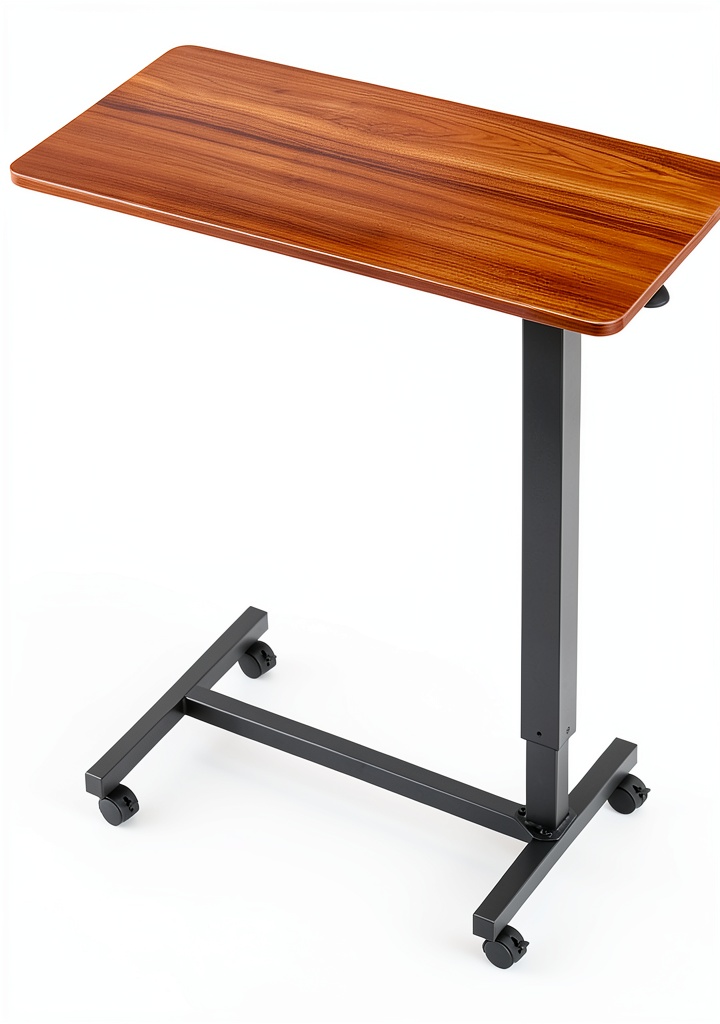
The Careboda strikes a balance between medical functionality and home aesthetics. Unlike many clinical-looking overbed tables with sterile white or chrome finishes, the rustic brown wood-grain top helps it blend into living spaces. During my testing, I used it in a home office setting, and visitors frequently commented that it looked like regular furniture rather than medical equipment.
The iron frame feels substantial without being excessively heavy. Each component has a solid heft that inspires confidence, and the powder-coated finish resists minor scratches well. However, I did notice that the finish can show fingerprints easily, requiring occasional wiping to maintain its appearance. The welding points are generally clean, though one joint had minor cosmetic imperfections that didn’t affect structural integrity.
The wood composite tabletop is where Careboda exceeds expectations. It’s not solid wood, but the surface has a convincing grain texture and adequate thickness. After several weeks of use with hot drinks, computer equipment, and occasional food spills, the surface showed no staining or damage when cleaned promptly. The rounded corners are a thoughtful safety touch, especially important for medical users or homes with limited space.
Performance in Real Use
I tested the Careboda in three primary scenarios: as a bedside table for recovery after minor surgery, as a mobile standing desk for remote work, and as a kitchen helper during meal preparation. Each scenario revealed different strengths and limitations.
Scenario 1: Bedside Recovery
After dental surgery, I used the Careboda for two days primarily from bed. The height adjustment range comfortably accommodated my medium-height bed (approx. 60cm mattress height) with plenty of adjustment room. The gas spring mechanism allowed easy one-handed adjustment while seated, though reaching the highest settings required getting out of bed for better leverage. The tabletop provided ample space for medications, drinks, and a tablet, but the straight legs prevented sliding it completely over my lap—a consideration for users who need direct over-the-lap positioning.
Scenario 2: Mobile Standing Desk
As a remote worker, I rotated the Careboda between my home office and living room for variety. The 110cm maximum height works well for users up to 6 feet tall in standing position, though the adjustment mechanism requires more force at maximum extension. The wheels roll smoothly on hardwood and tile but struggle slightly on medium-pile carpet. I appreciated being able to lock the wheels firmly when typing—no unwanted movement during intensive work sessions. The surface accommodated my 15″ laptop, second monitor, and notebook comfortably, though users with larger dual monitors might find the width limiting.
Ease of Use & Adjustment
The gas spring adjustment mechanism is the Careboda’s standout feature, but it operates differently than some might expect. Unlike hydraulic systems that require minimal effort, this gas spring needs moderate pressure to compress—especially at higher extensions. During testing, I found the sweet spot for effortless adjustment is between 80-100cm. Above 100cm, users with limited upper body strength might need two hands or additional leverage.
Assembly took approximately 25 minutes with the included tools. The instructions are visual-heavy with minimal text, which works well for most steps though the wheel installation diagram could be clearer. All necessary hardware is included, and the components fit together precisely without forced alignment. The most challenging part was attaching the gas spring mechanism, which requires holding multiple components simultaneously—an extra pair of hands would be helpful for some users.
Durability & Reliability
After four weeks of daily use, the Careboda shows no signs of wear beyond minor scuff marks on the wheel stems from moving across imperfect flooring. The tabletop surface has resisted scratches from computer equipment, though I recommend using a coaster for hot drinks as the finish can temporarily show heat rings that fade after cooling.
The locking mechanism has maintained consistent performance with no slippage noticed during testing. Each wheel locks independently, providing stability on uneven surfaces. The gas spring continues to hold position reliably at all height settings, even with near-maximum load. Long-term durability would depend on maintaining the mechanism—avoiding excessive side pressure during adjustment and keeping the wheels free of debris.
Pros & Cons
What works well:
- Smooth height adjustment across most of the range with positive locking at any position
- Attractive appearance that doesn’t scream “medical equipment” in home environments
- Solid weight capacity that handles typical loads without sagging or instability
- Easy mobility between rooms on hard surfaces with effective wheel locks
- Simple assembly with all necessary tools included in the package
What needs improvement:
- Straight-leg design limits how close the table can get to some bed frames
- Adjustment force increases significantly at maximum height settings
- Basic wheel quality performs adequately but isn’t premium-grade
- Surface could benefit from more explicit waterproof coating for liquid protection
- No cable management features for organized workspace setup
Comparison & Alternatives
Understanding where the Careboda fits in the market requires comparing it to both budget and premium options. Based on hands-on experience with similar products, here’s how it stacks up.
Budget Alternative: Generic Manual-Pin Adjustment Table ($35-50)
Basic overbed tables with manual pin adjustment represent the entry-level market. These typically feature a simpler mechanism where you pull a pin and adjust height in preset increments.
When to choose budget: If you need infrequent height changes, have limited budget constraints, or primarily need a static bedside surface. The trade-off is significantly less convenience—adjusting height requires emptying the table, finding the pin, and manually supporting the weight during adjustment.
Careboda advantage: The gas spring mechanism provides infinitely variable adjustment without emptying the table. The Careboda also typically offers better build quality and more attractive materials than entry-level options.
Premium Alternative: Havertys Hydraulic Overbed Table ($150-200+)
High-end medical-grade tables feature hydraulic systems, larger tabletops, and premium casters designed for clinical environments.
When to choose premium: For daily medical use, heavier equipment requirements, or users who need effortless single-finger adjustment. Premium models often include features like tilt-adjustable tops, electronic height memory, and antimicrobial surfaces.
Careboda value proposition: At approximately one-third the price, the Careboda delivers 80% of the functionality for home users. The gas spring, while requiring more effort than hydraulic systems, provides smooth adjustment without the premium cost.
Buying Guide: Who Should Buy This Table
Best For These Users:
- Remote workers needing a mobile standing desk solution that moves between rooms
- Patients recovering from surgery or with temporary mobility limitations
- Seniors who need adjustable height for comfortable reading, eating, or hobbies
- College students in dorms needing multi-purpose furniture for limited spaces
- Caregivers who need to move surfaces between patients or rooms
Not Recommended For:
- Users requiring direct over-the-lap positioning (the straight legs prevent this)
- Environments with thick carpet where wheel mobility is challenging
- Applications needing to support medical equipment over 25kg
- Users with significant upper body strength limitations who need effortless adjustment
- Outdoor or wet environment use as it’s designed for indoor only
Frequently Asked Questions
How much strength is needed to adjust the height?
Moderate hand strength is required, particularly at higher extensions. Most adults can operate it with one hand up to about 100cm, but the highest settings may require two hands or additional leverage. Users with arthritis or limited grip strength should test adjustment before purchasing if possible.
Can it be used as a permanent standing desk?
Yes, with caveats. The 110cm maximum height works for users up to 6′ tall. The surface area is adequate for a laptop and monitor but may feel cramped for extensive paperwork. The stability is sufficient for typing but avoid leaning heavily on the edges.
How does it handle on different floor surfaces?
Excellent on hardwood, tile, and laminate floors. Moderate performance on low-pile carpet. Challenging on thick carpet where wheels may sink and become difficult to roll. The wheel locks work effectively on all surfaces tested.
Is the wood surface waterproof?
The surface has some resistance to moisture but isn’t fully waterproof. Spills should be wiped promptly to prevent potential damage. Using coasters for drinks is recommended for long-term preservation.
What’s the actual under-bed clearance?
The straight legs provide approximately 15cm (6 inches) of clearance at their closest point. This works with most platform beds but may not fit traditional bed frames with lower rails. Measure your bed’s clearance before purchasing.
Is this worth the price compared to cheaper alternatives?
For users who need frequent height adjustment, absolutely. The gas spring mechanism justifies the price difference through convenience and smoother operation. If you’ll rarely adjust the height, a basic pin-adjustment model might suffice.
After extensive testing, the Careboda ABD-01 proves itself as a well-executed balance of functionality, aesthetics, and value. It’s not without limitations—the adjustment requires reasonable strength, the straight legs limit some positioning options, and the wheels are basic but functional. However, for the price point, it delivers reliable performance that surpasses expectations. If your needs align with its strengths—mobile height adjustment for home office, recovery, or multi-purpose use—the Careboda represents one of the better values in the adjustable table market.